
It emphasised that agricultural infrastructure needs considerable investments and hence Section 80IA benefits must be extended to all such investments like IT infrastructure, computers, VSAT, solar panels, water harvesting facilities, storage etc.

'The President of India, as advised by the prime minister, has accepted the resignation of Harsimrat Kaur Badal from the Union Council of Ministers, with immediate effect,' the Rashtrapati Bhavan said in a statement.

India and Australia would now implement the free trade agreement on a mutually agreed date as the Australian Parliament on Tuesday approved the pact between the two countries. "BREAKING: Our Free Trade Agreement with India has passed through parliament," Australian Prime Minister Anthony Albanese said in a tweet. The India-Australia Economic Cooperation and Trade Agreement (AI-ECTA) needed ratification by the Australian parliament before its implementation.

India's gold imports, which have a bearing on the country's Current Account Deficit (CAD), rose 6.4 per cent to $12.9 billion during April-July this fiscal due to healthy demand, according to government data. The imports stood at $12 billion during the same period a year ago. In July 2022, however, imports of the precious metal fell sharply by 43.6 per cent to $2.4 billion, as per the latest data released by the commerce ministry.

The Department for Promotion of Industry and Internal Trade (DPIIT) will soon start public consultation for a national retail trade policy, which is likely to include an insurance scheme aimed at providing financial protection against losses caused by theft, accidents or natural calamities. The policy will also spell out ways to give traders access to low-cost finance, promote digital inclusion, and create necessary infrastructure to support them, a senior government official told Business Standard. This is expected to offer relief especially to traditional traders, who are facing stiff competition from large e-commerce players.

The output of eight core sectors grew by 11.6 per cent in August, mainly due to an uptick in the production of cement, coal, and natural gas, official data showed on Thursday. The eight infrastructure sectors of coal, crude oil, natural gas, refinery products, fertilisers, steel, cement and electricity had contracted by 6.9 per cent in August 2020 due to the nationwide lockdown imposed to control the spread of COVID-19. The eight core industries comprise 40.27 per cent of the weight of items included in the Index of Industrial Production (IIP).

The time is opportune for doing away with the practice of a separate rail budget, and for replacing the railway ministry with an umbrella ministry of transport.

The wholesale price-based inflation declined to a 21-month low of 5.85 per cent in November on easing prices of food, fuel and manufactured items. After remaining in double digits for 19 months, the wholesale price index (WPI) based inflation declined to 8.39 per cent in October. The inflation was 14.87 per cent in November 2021. "Decline in the rate of inflation in November 2022, is primarily contributed by fall in prices of food articles, basic metals, textiles, chemicals & chemical products and paper & paper products as compared to the corresponding month of the previous year," the commerce and industry ministry said on Wednesday.

The government is likely to extend fiscal incentives for production of toys, bicycles and leather and footwear in the forthcoming budget as it looks to expand production linked incentive (PLI) scheme to cover more high-employment potential sectors, sources said. The government has already rolled out the scheme with an outlay of about Rs 2 lakh crore for as many as 14 sectors, including automobiles and auto components, white goods, pharma, textiles, food products, high efficiency solar PV modules, advance chemistry cell and speciality steel. The scheme aims to make domestic manufacturing globally competitive and create global champions in manufacturing, and it is yielding solid results, sources said.

However, in recent times, the clout that trader bodies such as CAIT and other organisations like Swadeshi Jagran Manch and Laghu Udyog Bharati has is steadily increasing. Earlier this year, trader bodies were able to convince the government not to extend the deadline for implementation of the new norms in FDI policy on e-commerce.

The Union Cabinet on Wednesday approved revision in guidelines for providing direct to home (DTH) services in the country under which licenses would be issued for 20 years, Union minister Prakash Javadekar said. The Union Cabinet has also approved 100 per cent FDI in the DTH broadcasting services sector, Javadekar said, adding that while the commerce ministry had spoken of 100 per cent FDI in the DTH sector, the guidelines of the information and broadcasting ministry needed to be changed.

India and the US on Thursday said they are looking forward to the reconvening of the India-US Trade Policy Forum later this year to further enhance trade relationship and identify new areas for engagement.

Wholesale price-based inflation spiked to a record high of 15.08 per cent in April on rising prices across segments from food to commodities. The WPI-based inflation was 14.55 per cent in March and 10.74 per cent in April last year. "The high rate of inflation in April 2022 was primarily due to rise in prices of mineral oils, basic metals, crude petroleum & natural gas, food articles, non-food articles, food products and chemicals & chemical products etc. as compared to the corresponding month of the previous year," the commerce and industry ministry said in a statement.

Mobile phones, televisions, refrigerators, laptops and stationary items will be allowed to be sold through e-commerce platforms like Amazon, Flipkart and Snapdeal from April 20 during the lockdown, officials said on Thursday. The clarification from a senior home ministry official came a day after Union home secretary Ajay Bhalla issued revised guidelines for the extended lockdown period till May 3.

Wholesale price-based inflation rose to a record high of 15.88 per cent in May on rising prices of food items and crude oil. The Wholesale Price Index-based inflation was 15.08 per cent in April and 13.11 per cent in May last year. "The high rate of inflation in May, 2022 is primarily due to rise in prices of mineral oils, crude petroleum & natural gas, food articles, basic metals, non-food articles, chemicals & chemical products and food products etc. as compared to the corresponding month of the previous year," the commerce and industry ministry said in a statement.

The background work of creating a suitable digital architecture of a website also remains unfinished as it has been a challenge to shortlist technology partners.

The prime minister, who is visiting the US at the invitation of President Biden and First Lady Jill Biden, will join them for the state banquet along with a number of dignitaries on Thursday.

The government is working towards further review and simplification of the foreign direct investment (FDI) policy to facilitate the proposed initial public offering (IPO) of the Life Insurance Corporation (LIC), Department for Promotion of Industry and Internal Trade (DPIIT) secretary Anurag Jain said on Thursday. The final decision will be taken by the Cabinet. The industry department is working together with the finance ministry's department of financial services (DFS) and department of investment and public asset management (DIPAM) towards a successful listing of the life insurer on the domestic bourses, which is expected to be the largest in India.

Singapore-based e-commerce platform Shopee - that launched in India only in December 2021 - has decided to close operations in the country. The official reason given by Shopee, which is controlled by NYSE-listed Sea Ltd, is changing global sentiments. In a statement, it said, "In view of the global market uncertainties, we have decided to close risks of our early-stage Shopee India initiative." The e-commerce platform has been hit by growing opposition from trade associations led by Praveen Khandelwal as well as homegrown social commerce start-ups.

HCL Tech was the top gainer in the Sensex pack, rising around 3 per cent, followed by Tech Mahindra, Tata Steel, Wipro, NTPC and Titan. Nifty advanced 187.05 points to 16,801.25.

The government on Thursday tweaked curbs on imports of laptops and computers as it allowed importers to bring in shipments of IT hardware from overseas on a mere 'authorisation' upon detailing quantity and value. The new 'import management system' is aimed at monitoring shipments of laptops, tablets and computers into the country without hurting market supply or creating a cumbersome licensing regime. The announcement is likely to provide relief to companies in the IT hardware segment in India as they had flagged concerns over the imposition of a strict licensing regime for importers.

The central government and the Reserve Bank of India have devised a country-specific plan towards implementation of overseas trade in rupee, people aware of the matter said. To start with, a small number of banks will be allowed to manage cross-border transactions in domestic currency with a particular country. "Small countries that are dollar-deficient have shown interest in doing trade in rupee.

The apex body for liquor firms Confederation of Indian Alcoholic Beverage Companies has urged the government to gradually reduce customs duties on British alcoholic beverages under the proposed India-UK free trade agreement to support domestic players. India and the UK have formally launched negotiations for an FTA, under which duties would be reduced or eliminated on several goods traded between the two countries. The Confederation of Indian Alcoholic Beverage Companies (CIABC) has also suggested the government to ensure that the UK allows the selling of domestic whiskies as 'Indian Whisky', irrespective of whether they are made from malt, grain spirits or molasses-based spirits.

The probe is being conducted under various sections of the Foreign Exchange Management Act (FEMA) after the central probe agency recently received a communication from the commerce ministry seeking "necessary action" against e-commerce players like Amazon and Flipkart pertaining to certain multi-brand retail businesses and an observation made by the Delhi High Court in relation to Amazon.

Violation of the provisions entails a punishment of a jail term up to five years or with fine up to Rs 1 crore or with both, the ordinance released by the Ministry of Law and Justice on Thursday said.

Gogoi and Sarma have been locked in a war of words on 'X' since Wednesday on the issue of the chief minister's wife's company allegedly being given a credit subsidy of Rs 10 crore.

In the draft rules, among 681 listed professions, armed security guards, supervisors, surveyors, and carpenters (class I) are proposed to be treated as highly skilled professionals; electricians, tailors and drivers are skilled; cooks and cobblers as semi-skilled and dairy coolies, office peons and sweepers as unskilled.
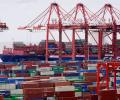
The country's exports for the first time crossed the $400 billion mark in a fiscal on healthy performance by sectors such as petroleum products, engineering, gems and jewellery, and chemicals, according to the commerce ministry's data released on Wednesday. The merchandise exports rose by by 37 per cent to $400.8 billion in 2021-22 until March 21 against $292 billion in 2020-21. Previously, the outbound shipments had touched a record of $330.07 billion in 2018-19.

Automobile dealers' body FADA has urged the government to formulate a task force to monitor the compensation structure being worked out by Ford India for its dealer partners across the country. In a letter to Heavy Industries Minister Mahendra Nath Pandey, FADA president Vinkesh Gulati also requested the government to instruct Ford India to keep the industry body in the loop regarding the compensation structure for the dealerships. "We humbly request your Ministry's intervention... Create a task force which takes day-to-day updates from Ford India to monitor the compensation plan for automobile dealers and dealership employees," Gulati said in the letter.

The report suggests that one of the major impacts of COVID-19 on the media and entertainment industry is the instability caused and the downfall in the advertising revenues across all media segments
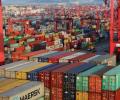
The country's exports grew by 47.19 per cent to $35.17 billion on account of healthy growth in the outbound shipments of petroleum, engineering, and gems and jewellery, according to the provisional data of the commerce ministry. Imports during the month also rose by 59.38 per cent to $46.40 billion, leaving a trade deficit of $11.23 billion. Exports of petroleum, engineering, and gems and jewellery in July increased to $3.82 billion, $2.82 billion and $1.95 billion respectively, the data showed.
The wholesale price-based inflation bucked the 4-month rising trend in December 2021, and eased to 13.56 per cent, mainly on account of softening in fuel, power and manufacturing items even though food prices hardened. WPI inflation has remained in double digits for the ninth consecutive month beginning April. Inflation in November was 14.23 per cent, while in December 2020 it was 1.95 per cent.

West Bengal's industry minister Partha Chatterjee, arrested in the SSC scam, should be removed immediately from his post and expelled from the Trinamool Congress, the party's state general secretary Kunal Ghosh demanded on Thursday.

According to the commerce and industry ministry data, during April-February 2018-19, the eight sectors recorded a flat growth rate of 4.3 per cent over the same period previous fiscal.

According to a commerce and industry ministry statement, the growth rate for these eight key sectors for April 2019 has been revised upward to 6.3 per cent from 2.6 per cent reported earlier mainly due to upward revisions in production of coal, crude oil, steel, cement and electricity.

Foreign direct investment (FDI) in India grew 40 per cent to USD 51.47 billion during April-December 2020-21, according to government data released on Thursday.

Fifteen Cabinet ministers and 28 Ministers of State were sworn-in by President Ram Nath Kovind at a ceremony at Rashtrapati Bhavan on Wednesday evening.
Exporters on Thursday demanded fiscal incentives, tweaking in customs duties on certain products and credit at affordable rates in the forthcoming Budget to boost exports and create jobs. In a pre-budget virtual meeting with Finance Minister Nirmala Sitharaman, the Federation of Indian Export Organisations (FIEO) said the depreciation of the rupee against the US dollar is affecting exports' competitiveness and the sector requires more support. "Creation of employment is the biggest challenge faced by the country...We would urge the government to provide fiscal support to units which provide additional employment in the export sector," the exporter's body said.

The country's exports rose by about 6 per cent to a "record" $447 billion during 2022-23 on account of healthy growth in the outbound shipments of sectors such as petroleum, pharma and chemicals and marine, Commerce and Industry Minister Piyush Goyal said on Thursday. The country's imports also grew by 16.5 per cent to $714 billion in 2022-23 as against $613 billion in 2021-22. He said that the exports of goods and services together scaled "new heights" and has increased by 14 per cent to $770 billion in 2022-23 as against 676 billion in 2021-22.

As many as 14 central government services have already been integrated with the e-biz portal.
